
Verbs Open Up Possibilities
Why saying "needs to reach" suggests more solutions than "needs a ladder": the origins, the psychology, and the limits of a rule of thumb in design thinking.
Photo: Thomas Quine (library ladder at Kenwood House, London), CC BY 2.0, via Wikimedia Commons
Summary
In design thinking classes, students are often told to state a need as a verb (“needs to reach”), not as a noun (“needs a ladder”). The advice is easy to remember and usable right away, but few people explain why it works. This article traces the advice back through design, marketing, and engineering, then draws on cognitive psychology for three reasons: a verb separates the need from the solution, it does not put a ready-made object in the listener’s head, and it moves the question one step closer to the purpose. It also says plainly where the advice falls short. A verb can still hide a solution inside it, and so far almost no experiment has directly tested whether verbs beat nouns.
1. The question
A design thinking instructor puts a photo on the screen: a small child stretching to reach a book on a high shelf. “What does this child need?” the instructor asks. Nearly the whole class answers at once: “A ladder.” The instructor says that is one option, then rewrites the question: “What if the child needs to reach?” Now the class starts thinking of other things: an extendable arm, shoes that add height, or simply asking a grown-up to get it. The instructor sums up: “verbs open possibilities.”
The same thing happens outside the classroom. A café owner complains, “the place needs more tables.” The family decides, “Grandma needs an app to remind her to take her pills.” A shopper says, “I need a power drill.” Each sounds like a need, but each has already picked its solution. Try rewriting them: the customer needs a seat without waiting, Grandma needs to remember her pills on time, I need to hang a picture on the wall. The café could sell takeaway or take reservations. Grandma could use a daily pill organizer next to the teapot. The picture could hang from adhesive hooks, no drilling, or simply lean on a shelf.
I want to understand three things better:
- Where does the rule “a need is a verb” come from?
- Why does changing a single word help people come up with more kinds of solutions?
- How right is this rule, and when does its magic run out?
The short answer of this article: a verb helps because it forces us to describe the thing the person wants to do, instead of naming an object we guess they need. The grammar is only a pretext. So treat the rule as a trick for reframing a problem, and like any trick, it sometimes slips.
2. Where the rule comes from
No single classroom invented it. At least four groups of people, in four different trades, reached the same idea on their own paths.
2.1. Needfinding at Stanford
The word “needfinding” is tied to Stanford’s product design program, and Patnaik and Becker (1999) wrote it up as a method. Their core point is simple: needs outlast solutions. People still need to store data, while floppy disks, CDs, and then USB sticks went into the drawer one after another. Whoever holds on to the need does not get buried with the product.
The Stanford d.school later put the idea into a sentence template for students: [user] needs [need] because [what we learned about them]. The middle slot must be a verb, the thing the person wants to do. Nielsen Norman Group adds that a need is the goal the user wants to reach, while a noun is often just the name of a solution, and clinging to it easily leads to poor design (Gibbons, 2019).
In the d.school’s familiar five-step model, this template is written at the second step, Define.
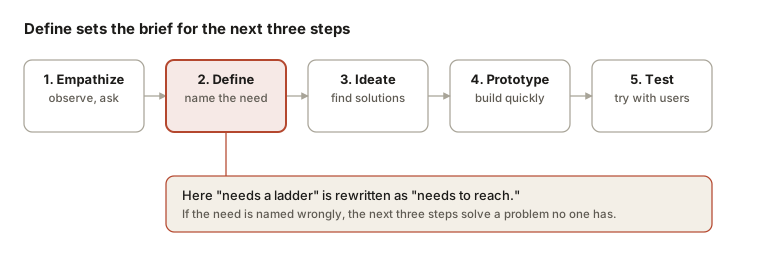
I think this is the most important step in the whole chain. However carefully you empathize, if you name the need wrongly, then ideating, prototyping, and testing are all solving the wrong problem. To be clear, this is the argument of this article, based on the research on problem construction in section 3.1. The d.school itself describes the five steps as a loop that goes back and forth, and ranks none of them.
2.2. Marketing: the hole and the milkshake
Levitt (1960) told the story of the American railroads declining because they saw themselves as railroad makers, while customers only needed to get from one place to another. He called it “marketing myopia.” The line “people don’t buy a drill bit, they buy a hole” is often credited to Levitt, though he himself quoted it from someone else. And going one step further, the hole is not the goal either: people want to hang a picture.
Christensen and colleagues (2016) pushed the idea into the “jobs to be done” theory. Christensen’s familiar example is the milkshake. A fast-food chain wanted to sell more milkshakes and kept tuning the flavor and the thickness. Only when the researchers stood and watched did they see that many commuters were buying a milkshake early in the morning. They needed to feel less bored and less hungry on a long drive. The milkshake’s competitors turned out to be the banana and the bagel.
2.3. Engineering: naming the function
Engineers did this earliest. From the 1940s, Miles built the method of value analysis, later published as a book (Miles, 1961). His rule: describe each function with just two words, a verb and a measurable noun. A switch “interrupts current,” a table leg “supports load.” Pahl and Beitz (1996) teach engineers to draw a function diagram before choosing a mechanism. Hirtz and colleagues (2002) even compiled a standard set of verbs so design teams speak the same language. All of it aims at one thing: say what it must do first, and decide what it is later.
2.4. Design research: framing the problem
Schön (1983) watched architects, doctors, and planners at work and saw that skilled professionals always “name and frame” a situation before solving it. Dorst and Cross (2001) followed experienced designers and found that problem and solution grow together: a new idea changes how you read the brief, and a new reading of the brief brings a new idea. Dorst (2011, 2015) treats building a new frame as the core of design thinking. Changing “a ladder” to “to reach” is the smallest reframe possible, and it costs a single word.
3. Why changing one word helps
Four lines of research in psychology and linguistics help explain what happened in that classroom.
3.1. Setting the problem is part of creativity
Getzels and Csikszentmihalyi (1976) gave art students a table full of objects and told them to arrange a still life and draw it. Some picked a few items quickly and started drawing at once. Others picked objects up and put them down, turned them this way and that, and changed the composition halfway through the drawing. Experts rated the drawings of the second group higher, and years later the same people were more successful in their field. Mumford and colleagues (1994) called this stage problem construction and placed it at the start of every creative process.
For messy social problems, Rittel and Webber (1973) went further and said outright: the way we state a problem already contains the direction of the solution. To say “the neighborhood lacks an overpass” is to have decided to build a bridge. To say “pedestrians need to cross the street safely” leaves room for signals, speed bumps, or moving the bus stop. “Needs a ladder” belongs to the same kind: a solution wearing the costume of a problem.
3.2. A name binds its use
Duncker (1945) gave participants a candle, a book of matches, and a box of thumbtacks, and asked them to fix the candle to the wall so that no wax dripped on the table. The solution is to empty out the tacks and pin the box to the wall as a shelf. Many people did not think of it, because to them the box was only a container for tacks. He called this phenomenon functional fixedness.
Words can steer this effect. Glucksberg and Weisberg (1966) simply gave the box its own label (“box,” separate from “tacks”), and the number of people who solved the problem rose clearly. McCaffrey (2012) turned that into an exercise: describe each part with words that do not hint at its use. “Wick” suggests burning, while “string” can tie up all kinds of things. The group trained this way solved about 67% more problems than the control group, though the experiment was fairly small.
Designers fall into a similar trap. Jansson and Smith (1991) showed engineers an example design before they started, and their drawings repeated the example’s features, including the places where the example was wrong. Anyone who teaches drawing knows the scene: the teacher draws a sample cat on the board, and the whole class turns in thirty identical cats. A noun that names a solution does the job of that sample drawing. The moment we hear “ladder” we see a ladder, and every idea afterward is a wooden ladder, an aluminum ladder, a folding ladder.
3.3. A noun is a thing, a verb is a relation
Gentner (1982) observed that concrete nouns point at things we see as whole units, which is why children learn them first. Verbs describe relations between things and always leave room for who or what takes part. Gentner and France (1988) also found that the meaning of verbs bends to context more easily than the meaning of nouns.
Applied here: “a ladder” is a finished object. “To reach” is a relation between the child and the book, with some slots left open. Reach with what? Who reaches? Do we change the child, the shelf, or the place of the book? Each open slot is a direction to think in.
3.4. The ladder of “what for”
Vallacher and Wegner (1987) showed that the same action can be named at several levels. Ask “what for?” and you go up a level; ask “how?” and you go down one. Trope and Liberman (2010) add that the higher you go, the more you look at purpose and the less you stick to concrete detail.
The story of the child has all four levels: a ladder, then reach the book, then get the book, then read a story. Changing a noun to a verb is really a step up one level. And if you climb to the level of “read a story,” solutions appear that the level of “reach” cannot see, such as another book on a low shelf, or a parent reading aloud.
4. Three reasons, together
Putting these strands together, I think a statement built on a verb opens more paths for three reasons that work together.
| Reason | “Needs a ladder” | “Needs to reach” | Based on |
|---|---|---|---|
| Separates the need from the solution | The solution is already chosen inside the question | States only the destination, not how to get there | Patnaik & Becker (1999); Rittel & Webber (1973) |
| Does not hint at an object | The listener sees the ladder at once, and later ideas revolve around it | There is no model to hold on to, so you have to look for something that does the job | Duncker (1945); Jansson & Smith (1991); McCaffrey (2012) |
| Moves up one level of “what for” | Stands at the level of “how” | Stands at the level of purpose, where many methods can answer it | Vallacher & Wegner (1987); Trope & Liberman (2010) |
If these three reasons hold, we can guess something that can be tested: a group given the brief in verb form will come up with more kinds of solutions, which is a stronger claim than simply more ideas. The classroom in the story fits this prediction. Their three ideas belong to three clearly different kinds: change the tool (an extendable arm), change the user (shoes that add height), ask someone else (a grown-up gets it). There is a fourth kind the class did not mention: change the environment, by lowering the shelf or putting children’s books on the bottom shelf.
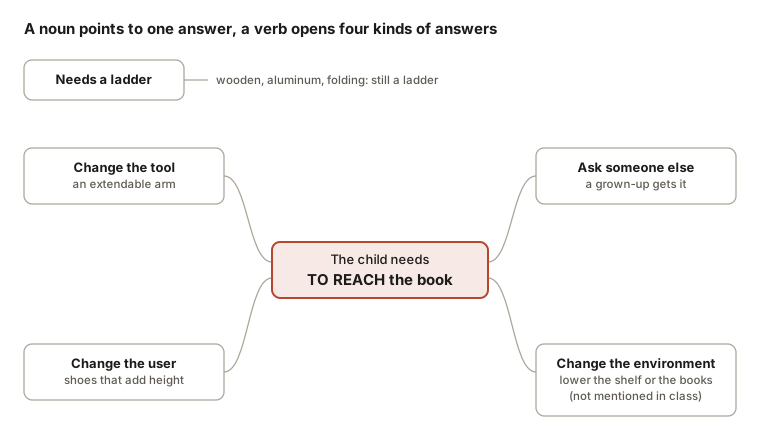
Read from the center outward: given the same photo, “needs a ladder” leads only to kinds of ladders, while “needs to reach” fans out into four very different branches.
The table below tries the same swap on a few familiar situations. Except for the elevator case, taken from Wedell-Wedellsborg (2017), the rows are examples I made up.
| Original statement (an object) | Rewritten (a task) | New paths that appear |
|---|---|---|
| The building needs a faster elevator | People waiting need to feel less impatient | Put a mirror by the elevator door, play music, add a notice board |
| The café needs more tables | Customers need a seat without waiting | Sell takeaway, take reservations, counter stools for people eating alone |
| Grandma needs a pill reminder app | Grandma needs to remember to take her pills on time | A daily pill organizer, pills next to the teapot, a grandchild’s phone call every evening |
| The drawing class needs more easels | Students need to see their own work from a distance | Pin the drawings to the wall, take a photo and shrink it, stand up and step back three paces |
| I need a drill | I need to hang a picture | Adhesive hooks, double-sided tape, lean the picture on a shelf |
| The staff needs one more meeting | The whole team needs to know who is doing what | A shared task board, an end-of-day update message |
5. Where this advice runs short
Even a good trick has limits. I see five places to be careful.
A verb can hide a solution too. “The child needs to climb up” is a proper verb, yet it has already chosen the way to solve the problem. Even “to reach” quietly assumes that the child must go to the book, and forgets the possibility of the book coming to the child. What to examine is whether the sentence leaves the how open; the part of speech is only a surface sign.
Go too high and it stops being useful. “The child needs to be happy” is true, but nobody knows where to start. “Customers need a good experience” is the same. A usable sentence sits in the middle: wide enough for several kinds of solutions, narrow enough that you can sit down and think of an idea right away.
Guessing from a photo is still guessing. Both “a ladder” and “to reach” were inferred by the class from one photo. Patnaik and Becker (1999) warn that after observing you must ask, because only the person involved knows what they are doing something for. Perhaps the child wants to get it alone, to show they have grown up. Then “ask a grown-up to get it” is a failed solution, even though it came from a perfectly good verb.
Direct evidence is thin. The research in section 3 supports this advice indirectly. In the sources I could read, no experiment splits people into two groups, one given a noun sentence and one a verb sentence, and then counts which group comes up with more kinds of solutions. For now it remains craft knowledge passed from hand to hand.
Vietnamese does not mark parts of speech the way English does. English clearly separates “a ladder” from “to reach.” Vietnamese does not inflect words, and just adding “sự” or “việc” makes a verb stand like a noun: “sự tiếp cận” (access), “việc với tới” (the act of reaching). The sentence “học sinh cần sự hỗ trợ” (“students need support”) looks like a noun but does not name any object, it is only too vague. For people writing in Vietnamese, the test question should be: after “need,” is it an item or a thing to do?
6. How to use it, and what still needs testing
6.1. At work or in class
- Ask “item or thing to do?” Reread the need statement you just wrote. If what follows “need” is an item, keep asking “what for?” until you reach a thing to do. “Needs a projector” for what? So the whole class can see the model drawing clearly.
- Go up, then go down. “What for?” takes us up, “how?” takes us down. Stop at the level where you can name at least three different kinds of solutions.
- Try swapping roles. Does the child reach for the book, or does the book come to the child? Does the customer go to the café, or does the café go to the customer? Every verb has a subject, and changing the subject often brings a new idea.
- Ask the people involved. A complete statement has three parts: who, needs to do what, why. The “why” only comes when we ask them.
- Turn it into a question for the whole group. From “Grandma needs to remember her pills on time” to “How can Grandma remember her pills without touching her phone?” is a single step.
6.2. An experiment worth running
This advice can be tested, and the method is not hard. Randomly split participants into three groups. All look at the same photo, but each gets a different brief: “the child needs a ladder,” “the child needs to reach the book,” “the child needs to be read a story.” Give each person five minutes to write down ideas. Then count the ideas, count the kinds of solutions, and ask outsiders to rate how new the ideas are.
There are two more questions I have not seen anyone answer. Do veterans still need this trick, or have they already reframed in their heads? And does the effect survive in Vietnamese, where the line between noun and verb is much softer?
7. Conclusion
“Verbs open possibilities” is a short way of saying something that designers, marketers, and engineers all found on their own: describe what people want to do first, then think about the object that helps them do it. A verb helps because it pulls the solution out of the question, does not plant an object in the listener’s head, and brings us one step closer to the purpose. It can still be wrong. Pick the wrong verb and the door stays shut, and even a right one still means going to ask real people.
What I keep from the ladder exercise is a small habit. Each time “this needs…” pops out, pause for half a second to check whether you have just named a need or just picked a solution.
References
- Christensen, C. M., Hall, T., Dillon, K., & Duncan, D. S. (2016). Know your customers’ “jobs to be done”. Harvard Business Review, 94(9), 54–62.
- Dorst, K. (2011). The core of “design thinking” and its application. Design Studies, 32(6), 521–532.
- Dorst, K. (2015). Frame innovation: Create new thinking by design. MIT Press.
- Dorst, K., & Cross, N. (2001). Creativity in the design process: Co-evolution of problem–solution. Design Studies, 22(5), 425–437.
- Duncker, K. (1945). On problem-solving. Psychological Monographs, 58(5), i–113.
- Gentner, D. (1982). Why nouns are learned before verbs: Linguistic relativity versus natural partitioning. In S. Kuczaj (Ed.), Language development: Vol. 2. Language, thought, and culture (pp. 301–334). Erlbaum.
- Gentner, D., & France, I. M. (1988). The verb mutability effect: Studies of the combinatorial semantics of nouns and verbs. In S. L. Small, G. W. Cottrell, & M. K. Tanenhaus (Eds.), Lexical ambiguity resolution (pp. 343–382). Morgan Kaufmann.
- Getzels, J. W., & Csikszentmihalyi, M. (1976). The creative vision: A longitudinal study of problem finding in art. Wiley.
- Gibbons, S. (2019). User need statements: The “Define” stage in design thinking. Nielsen Norman Group.
- Glucksberg, S., & Weisberg, R. W. (1966). Verbal behavior and problem solving: Some effects of labeling in a functional fixedness problem. Journal of Experimental Psychology, 71(5), 659–664.
- Hasso Plattner Institute of Design at Stanford. (2010). Bootcamp bootleg. Stanford d.school.
- Hirtz, J., Stone, R. B., McAdams, D. A., Szykman, S., & Wood, K. L. (2002). A functional basis for engineering design: Reconciling and evolving previous efforts. Research in Engineering Design, 13(2), 65–82.
- Jansson, D. G., & Smith, S. M. (1991). Design fixation. Design Studies, 12(1), 3–11.
- Levitt, T. (1960). Marketing myopia. Harvard Business Review, 38(4), 45–56.
- McCaffrey, T. (2012). Innovation relies on the obscure: A key to overcoming the classic problem of functional fixedness. Psychological Science, 23(3), 215–218.
- Miles, L. D. (1961). Techniques of value analysis and engineering. McGraw-Hill.
- Mumford, M. D., Reiter-Palmon, R., & Redmond, M. R. (1994). Problem construction and cognition: Applying problem representations in ill-defined domains. In M. A. Runco (Ed.), Problem finding, problem solving, and creativity (pp. 3–39). Ablex.
- Pahl, G., & Beitz, W. (1996). Engineering design: A systematic approach (2nd ed.). Springer.
- Patnaik, D., & Becker, R. (1999). Needfinding: The why and how of uncovering people’s needs. Design Management Journal, 10(2), 37–43.
- Rittel, H. W. J., & Webber, M. M. (1973). Dilemmas in a general theory of planning. Policy Sciences, 4(2), 155–169.
- Schön, D. A. (1983). The reflective practitioner: How professionals think in action. Basic Books.
- Trope, Y., & Liberman, N. (2010). Construal-level theory of psychological distance. Psychological Review, 117(2), 440–463.
- Vallacher, R. R., & Wegner, D. M. (1987). What do people think they’re doing? Action identification and human behavior. Psychological Review, 94(1), 3–15.
- Wedell-Wedellsborg, T. (2017). Are you solving the right problems? Harvard Business Review, 95(1), 76–83.
- thewandress1512. (2024, July 15). Social media post about a Design Thinking class at Columbia (source of the opening story, from screenshots).
Note. The information comes from books I consulted, together with my own discussion. The diagrams are my own drawings.