Roji: The Path to the Tea House
A roji is a small Japanese garden made for walking, not for sitting and looking. From the zigzag gate to stepping stones, a water basin and a tiny crawl-in door, each stage makes you slow down, and three tea masters thought about nature in three different ways.
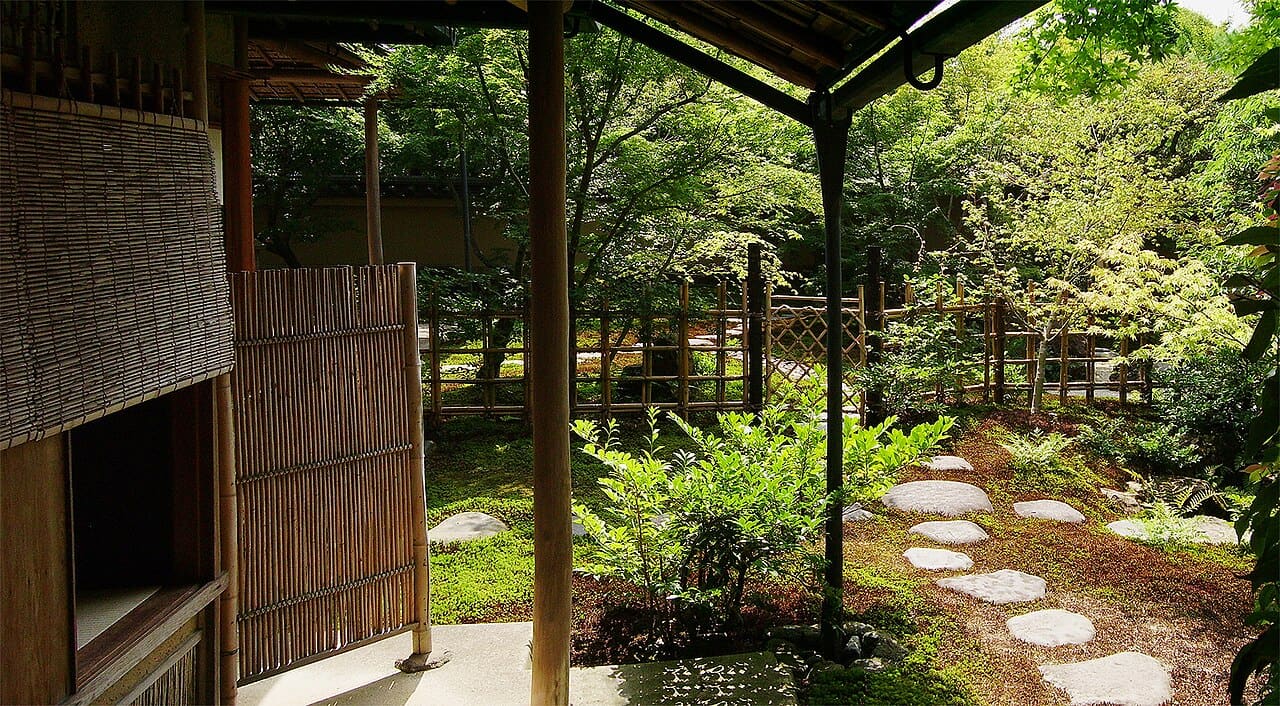
Photo: Bjoernord, CC BY-SA 3.0, via Wikimedia Commons (roji and crawl-in door at the Adachi Museum of Art, Shimane)
This example is mine, not a memory. You visit a friend who has just moved into a deep alley. The iron gate is low, and you duck to avoid the sign. The alley is narrow, so you walk slowly. In the yard you wash your hands at a tap close to the ground, because your friend put a pot of herbs right there. By the time you reach the door you are no longer in a hurry. Nobody told you to slow down, but the alley, the gate and the tap did it for them.
The Japanese do this on purpose, and they call it the roji.
A Garden for Walking
Roji literally means “dewy path” or “field path.” According to Günter Nitschke in Japanese Gardens (Taschen, 2003), it is a new kind of garden that appeared in the Momoyama period, in the late 16th century (pp. 146–162). It is small, and quite unlike the pond garden for boating or the gravel court you look into from outside. A roji has no best viewpoint. It is the path to the so-an, the tea hut, and walking that path is already part of the tea gathering, like a rite of passing a threshold.
If you read Ryoan-ji: Three Ways to Read a Gravel Courtyard, you remember that dry garden sits its viewers still on a veranda. The roji does the opposite: it makes you stand up. It shares the idea of a picture you walk into with Central Park, shrunk to a few dozen steps.
The Sequence at Omote Senke
Nitschke describes the roji through the garden of the Omote Senke family in Kyoto. I rearranged its stages into a conceptual diagram:
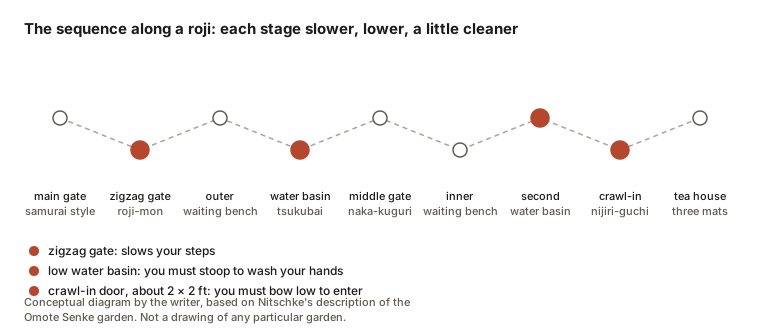
Read in order, a few things repeat:
- The first gate looks like a samurai house gate, but behind it lies a front yard with a trimmed hedge about 6 ft (roughly 1.8 meters) high.
- The roji-mon gate is laid out in a zigzag, so you cannot walk straight through it.
- There is an outer waiting bench, then a tsukubai water basin, then a crawl-in door into the middle roji. In the inner roji there is another bench, a stone lantern, a second basin, and finally the nijiri-guchi, the crawl-in door to a three-mat tea room.
The chain cuts a small garden into many pockets, each with a small task: wait, wash, bow, step.
Stepping Stones, Basins, Crawl-in Doors
Three things carry most of the roji’s work.
Stepping stones (tobi-ishi). Stones set apart from one another, holding moss, guiding both eye and foot. According to the note, the result is that you have to look at your feet first, and only then lift your eyes to the scene. The view arrives in beats, in time with your steps.
The water basin (tsukubai). The name means “a place where you must crouch.” The basin sits low so that anyone who wants to wash must bend. Around it are secondary stones, such as one for a kettle of hot water, one for a lantern, and a standing stone. Stone lanterns tend to sit at an unexpected bend, near a gate or beside a basin.
The crawl-in door (nijiri-guchi). The way into the tea house is only about 2 × 2 ft, roughly 60 cm each way. To get through, you have to bow low, almost crawl. The note adds something I find interesting: the crawl-in door changes proportions, so when you drop into the three-mat room it feels larger. My guess is that once your body has gone low, the scale of the room shifts with it (that part is my speculation).
My notes group the three devices together: slowing, lowering, cleansing. What is worth learning is the device, not the form. The Buddhist and Zen ritual behind them belongs to one culture, and I would not carry it unchanged into a yard in Vietnam or anywhere else. But slowing a guest at the threshold is something any house can try.
Three Tea Masters, Three Attitudes to Trees and Stones
In the same roji, each tea master thought about nature differently. Nitschke uses three of them to mark a turning point in the relation between people and nature (pp. 147–163):
| Tea master | What he wanted | Signs in the garden |
|---|---|---|
| Rikyu | Wabi: plainness, restraint, smallness. Imitate the “way nature works” | Natural stones, evergreens, damp moss, the image of a rustic hut set in the city |
| Oribe | Suki: personal taste, a touch of playfulness | Paving that mixes dressed stones with natural ones, leaves swept and pine needles spread; according to a scholar Nitschke cites, he made a “second nature” |
| Enshu | Kirei-sabi: elegance and the marks of time | Trees too must bow to human will, carefully trimmed |
A garden book from 1694, Shokoku chaniwa meiseki zue, draws all three: a Rikyu-style garden of pure nature, an Oribe-style garden with dressed-stone paths, lanterns and basins, and an Enshu-style garden neatly trimmed.
The note holds two more details. One is that Rikyu wanted function to count for 60 percent and aesthetics for 40, while Oribe reversed the ratio. The other is the use of rectangular dressed stones among natural ones: according to the note, they bring out the natural, undefined shape of the stones around them. Last is the anecdote of Rikyu sweeping the yard clean, then shaking a tree so a few leaves fell.
A Question to Carry
Nitschke is a scholar with strong views, and the three-master division is his argument; the reality was far messier. Still, those three attitudes work as a question you can ask of any garden: will I keep it as it is, nudge it, or make it new?
The next time you walk through a gate or an entrance, count where it slows you down: a step, a bend, a low door, a spot where you have to wait. If there is none, imagine where you would put one, and see whether it changes how you enter the house.
Note. The information comes from books I consulted, together with my own discussion. The diagrams are my own drawings.