People Go Where People Are
Why every café turns its chairs toward the street: Jan Gehl and the small measurements of where people stop, where they sit, and how far apart they can still hear each other.
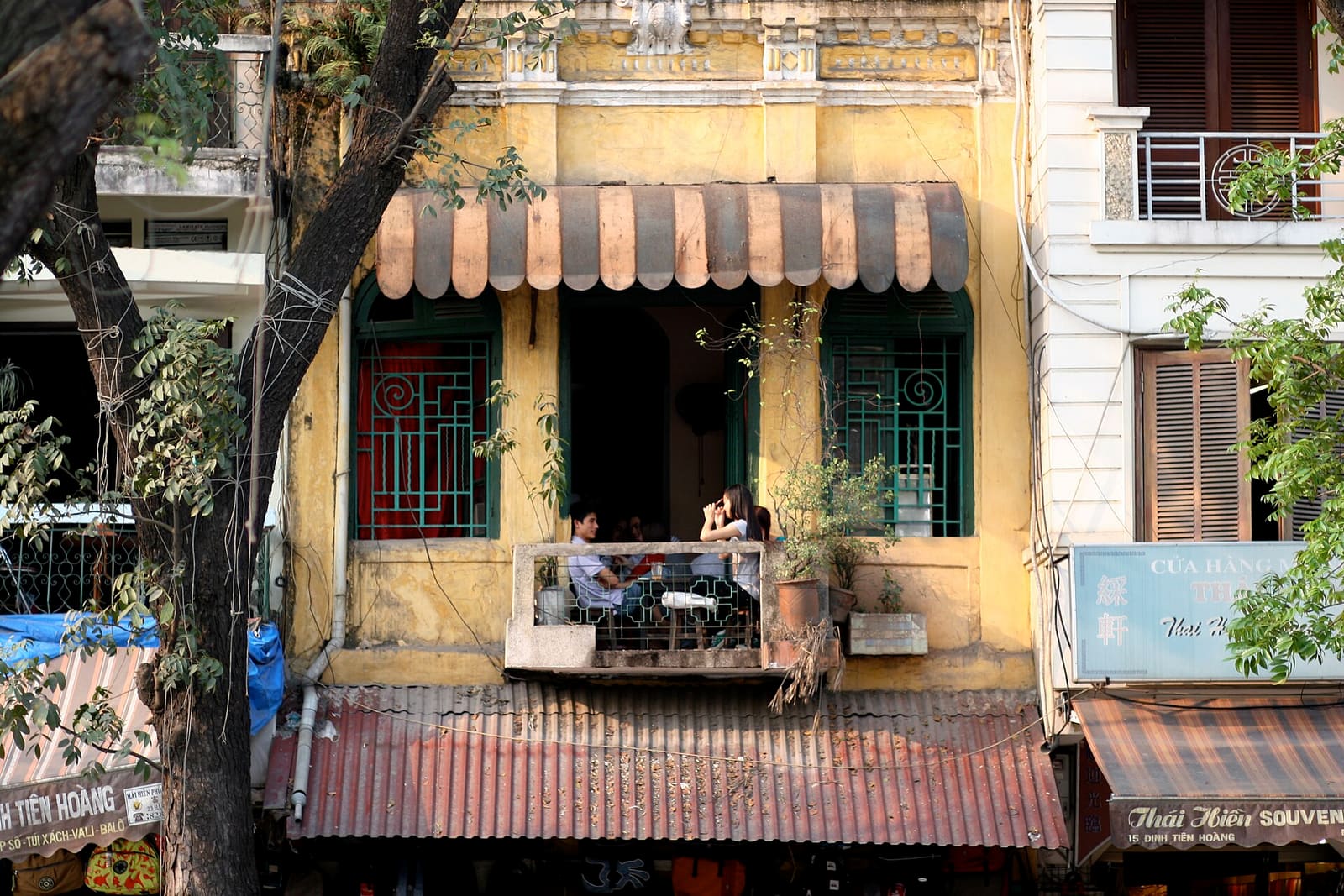
Photo: Nam-ho Park, CC BY 2.0, via Wikimedia Commons
Look around and you will see that sidewalk café chairs almost always face the street. Nobody sets a chair to face the wall, even though the wall is cleaner, cooler, and less dusty. People sit to watch the street, and to watch the people walking along it.
Danish architect Jan Gehl spent many years trying to understand this simple fact. He repeats a Nordic saying: people go where people are. His book Life Between Buildings came out in the early 1970s as a critique of planning in the Functionalist mold; the Vietnamese edition is Cuộc sống giữa những công trình kiến trúc (translated by Lê Phúc Quốc, Construction Publishing House, 2009). His method is almost nothing more than standing, watching, and counting: which chairs are occupied, where people stop.
People Like to Watch People
According to Gehl, people pay more attention to activity and other people than to buildings or objects (section 1.2, pp. 15–30). What he observed in Copenhagen sounds like everyday life:
- People stop in front of shop windows showing things tied to daily life, such as newspapers, photos, and toys, and rarely stop in front of banks or offices.
- A construction site in full swing draws onlookers. At the lunch break, nobody stops.
- Live music or a street painter keeps pedestrians around longer than a loudspeaker does.
- Seats facing a busy walkway get used more than seats facing a tree.
- Children play in the street, in parking lots, and at doorways more than in playgrounds built just for them.
From this, Gehl concludes that a street full of color and shapes but empty of people is still poor in experience, and sad. He calls such streets desert streets.
How Far We Can See and Hear
One thing few people think about: eyes and ears only reach so far. Gehl calls the zone of about 100 m around us the “social field of vision,” then measures what we can still see and hear at each distance (section 2.2, pp. 64–71).
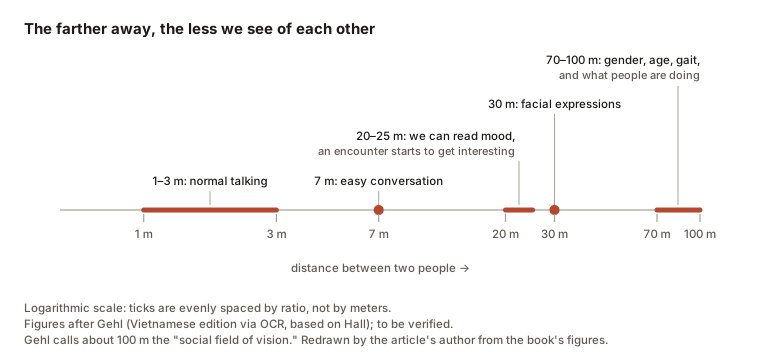
At 70–100 m we can only tell whether someone is a man or a woman, old or young, how they walk, and what they are doing. At about 30 m we can see facial expressions. At 20–25 m we can read their mood, and according to Gehl, that is when an encounter starts to get interesting. Within about 7 m, conversation is still easy; 1–3 m is the ordinary distance for talking. Hall divides the nearer distances into four zones: intimate (up to 0.45 m), personal (0.45–1.3 m), social (1.3–3.75 m), and public (beyond 3.75 m).
These distances match a few familiar numbers: the farthest seat in a theater is only about 30–35 m away, and a sports field is about 70 m. Gehl adds an observation: small spaces feel warm, large spaces feel cold.
I tried laying the cover photo over this ruler. The two people sitting on the balcony one floor above the street are perhaps a few meters from the sidewalk, which puts them well within easy conversation range. That is my guess from the photo, not a real measurement.
Three Meters in Front of the Door
The place where a house meets the street is where Gehl pays special attention. According to my notes on the book, a front yard about 1 m deep is too shallow for conversation, while one that is too deep makes it hard to strike up a chat; surveys suggest about 3 m is usable. In the Galgebakken neighborhood, semi-private front yards about 4 m deep helped raise outdoor activity by roughly 35%. These two figures come from two different places in my notes, so I treat them as rough guides.
NACTO’s street design guide (2016) makes the same point another way, through the idea of “active building edges”: a ground floor with many entrances, open glass that lets you see inside, awnings, signs at pedestrian scale, lighting, climbing plants. My notes add one observation: Vietnamese street-front townhouses already have this advantage, because the shop opens onto the street from the start. The plastic stools in front of a corner shop, the awning, and the step where people sit with iced tea are my own examples.
Too Loud, and Nobody Stays
To talk, people have to be able to hear each other. A pedestrian street runs at about 50 dB; above 60 dB, according to Gehl, ordinary conversation is no longer possible (sections 4.5–4.6, pp. 167–185). How seats are arranged also decides whether a conversation can begin: seats back to back, or far apart, make talking hard; seats set at right angles or in a curve make it easy to start a conversation and just as easy to step out of one.
I see this most clearly in cafés right next to a busy motorbike road, where the horns force everyone to speak louder. That is my own observation, not a measurement.
The Longer People Stay, the More People Stay
Gehl calls this a self-reinforcing effect: what matters is how long people stay. According to my notes, if daily time spent outdoors rises from 10 to 20 minutes, activity can double. A place where someone is sitting draws more sitters, and an empty place stays empty.
Where to Be Careful
Gehl studied Northern Europe, where people like sun and fear cold wind. In the tropics, the main concerns are shade, ventilation, and rain. Choosing seats by microclimate still works, but the answer is different. Hall’s zones are also based on Western culture, so the numbers above are best treated as a starting point.
You can try it yourself, Gehl’s way: stand for ten minutes on a stretch of street you know, and count where people stop, where they sit, and which chair always has someone on it. Then ask yourself: if I moved that chair one meter, what would happen?
Note. The information comes from books I consulted, together with my own discussion. The diagrams are my own drawings.