Kimbell: Making the Sun Take a Detour Before It Touches the Paintings
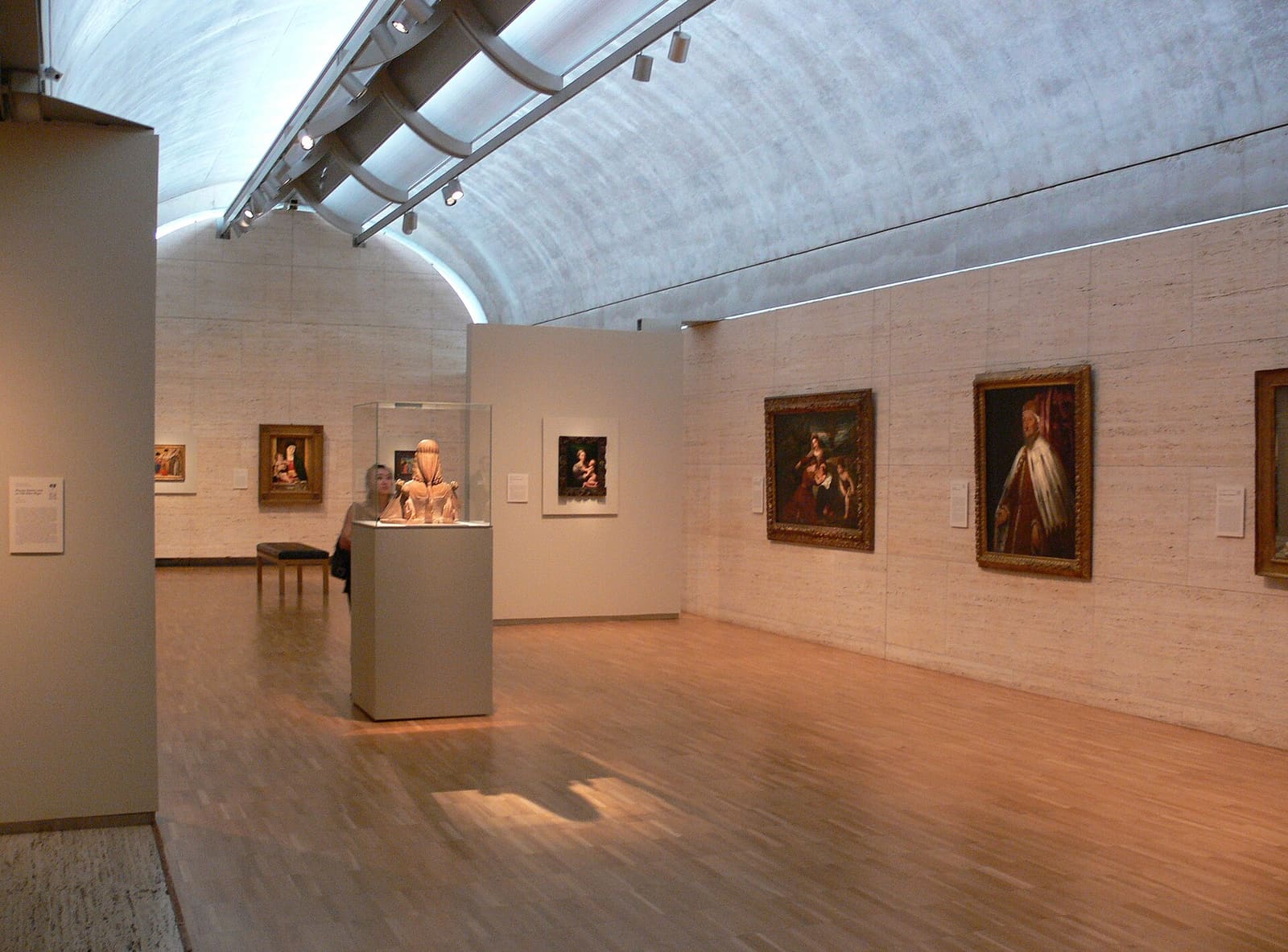
Louis Kahn's Kimbell Art Museum brings daylight into the galleries without letting direct sun touch the paintings: a slit at the top of each vault, a reflector, and a structure that produces light.
Photo: Andreas Praefcke, public domain, via Wikimedia Commons
Anyone who has hung a family photo beside a west-facing window knows what happens after a few summers: the picture fades. Sunlight is good at bleaching exactly the things we want to keep. That is why many galleries are built windowless, with only lamps.
And yet in Fort Worth, Texas, people wanted the opposite. Kay Kimbell left his collection to the city. The museum’s director, Richard Fargo Brown, asked for natural light, the kind that is “warm, soft, even elegant,” and for a scale that suited human beings (Kahn, Essential Texts, Twombly 2003, the essay “Space and the Inspirations,” p. 220). The site also sat next to Philip Johnson’s Amon Carter Museum, so the building had to stay low so as not to block its neighbor’s view.
Asking for daylight without letting the sun touch the paintings sounds like two demands arguing. Kahn, who began the design in 1966, did not pick a side. He sent the sun on a detour.
A flash pointed at the ceiling
Photographers know a familiar trick: do not aim the flash straight at your subject, point it at a white ceiling. The light hits the ceiling and spreads back down, much softer, with no hard glare. The comparison is mine, but it is the closest thing to how the Kimbell works: use the whole ceiling as the reflector, and use the sun as the flash.
More precisely, the museum is a series of vaults. According to the notes in the books, each vault is 20 ft wide and 150 ft long, about 6 m by 46 m (I did the conversion). A narrow slit runs along the top of each vault. Light passes through the slit, meets a reflector hung just below it, is thrown up onto the inside of the vault, and spreads down into the room. The result is what people call “silver light”: direct sun never reaches the objects on display, yet visitors can still tell the time of day, because the light changes with the sky.
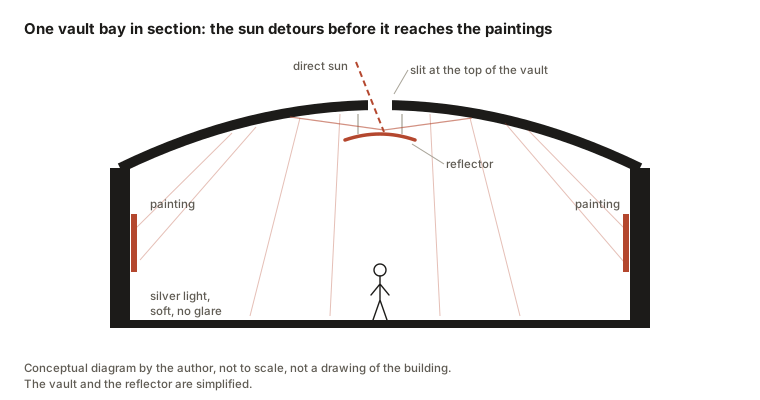
The picture above is a cross section of one bay, simplified by me to show the path of the light. The solid parts are the parts cut through: the two walls, the floor, and the vault shell with the gap at the crown. The dashed red line is direct sun, stopped at the reflector. The thin lines below are light that has been reflected once, heading down to the paintings on the walls.
A vault that is not a vault
From outside you would take it for a row of load-bearing vaults. Martin Filler, in the special issue of Arquitectura Viva on Kahn (2001), says it is not so: each vault is cut lengthwise by the slit, made of two segments that do not join, and the real structure relies on the method of the engineer August Komendant. The vault shape is there to serve the light. The notes in the books also advise checking the cycloid curve, the curve a point on a wheel’s rim traces as the wheel rolls, against the original drawings.
Some will call that fake. I think it is true to what Kahn believed: structure is the maker of light. Column next to column gives a rhythm of “light, no light” (he read the Parthenon that way). Choosing a vault or a flat roof is choosing the character of the light beneath it. For him a room becomes architecture only when it has natural light. Electric light is “the light of night,” able to hold only a single moment (notes on Kahn’s position, drawn from Essential Texts).
Three courts named after colors
Open courts cut across the vaults. People call them the Green Court, the Yellow Court and the Blue Court, named for the light, plants and water Kahn planned for each place.
The design did not arrive in one piece either. The building went through three stages of design, and Kahn tried an H-shaped plan and more courts before reaching the final scheme.
Three ways to bring light into a gallery
| Way of getting light | What you gain | What you lose |
|---|---|---|
| An ordinary window | A view, and you can tell the time of day | Direct sun, faded paintings, glare for visitors |
| A closed room lit only by lamps | Control over every detail | The feeling of day and night, the kind of light Kahn called the light of night |
| Slit at the top of a vault plus a reflector (Kimbell) | Daylight, softened, still telling the time | You must design a whole structure around the lighting; you must handle glare and ultraviolet rays; it suits low, spread-out buildings better than deep, closed ones in a crowded street |
The last two points in the final cell of the “What you lose” column are cautions found in the notes on Kahn’s light. The table is my arrangement.
The dark has to be designed too
In a talk at Pratt in 1973 (Essential Texts, p. 266), Kahn tells how he set himself an exercise: draw a picture that shows light. The white sheet is already light, so he could draw nothing. Only when he put down a few strokes of ink did he realize that the ink goes where the light does not reach, and the picture appeared from there. He cites an engraving by George Cruikshank: the lines grow thicker where there is less light, and near the fire it is almost bare paper.
From this he says that matter is spent light, and the shadow of matter belongs to light. From the same idea comes his remark about a dark room: it still needs a slit of light, enough for us to know how dark it is. The slit at the top of the Kimbell vault, as I read it, is that slit. To get soft silver light, you must first decide where it is allowed to be dark.
This reading is close to what Kahn did in Luanda, which I told in Good Light Is Not Plenty of Light. There he set a free-standing wall a few steps from the window so the sun hits the wall first. Here it is the reflector under the slit. Neither lets the sun go straight into the eye or onto the painting. Each puts a surface in the path to turn the sun into gentler light. That is my own connection, not Kahn’s.
What is not quite settled
Filler calls the Kimbell the best-loved art museum, “luxe, calme et volupté” (luxury, calm, pleasure), borrowing the title of a painting by Matisse. Remember that this is a critic’s judgment (Verdaguer thinks along similar lines), not a universal verdict.
One small detail deserves thought. According to the books, visitors today enter from the parking lot side, against Kahn’s intention: he wanted them to arrive from the side now treated as the back, the side facing the park and the Amon Carter. I have not checked the current situation, so I am not sure this is still true today. But it reminds us that even a building made with such delicate light can be read backwards from the front door.
Try finding, in your own home, a surface that is doing the reflector’s work: a white ceiling, the wall opposite a window, a sheer curtain. Does the sun pass through it before it reaches your eyes, or go straight in?
Note. The information comes from books I consulted, together with my own discussion. The diagrams are my own drawings.