Ryoan-ji: Three Ways to Read a Gravel Courtyard
A flat courtyard of white gravel, fifteen stones, no water, no trees. Three Japanese dry gardens offer three different readings, and none of them is the one true answer.
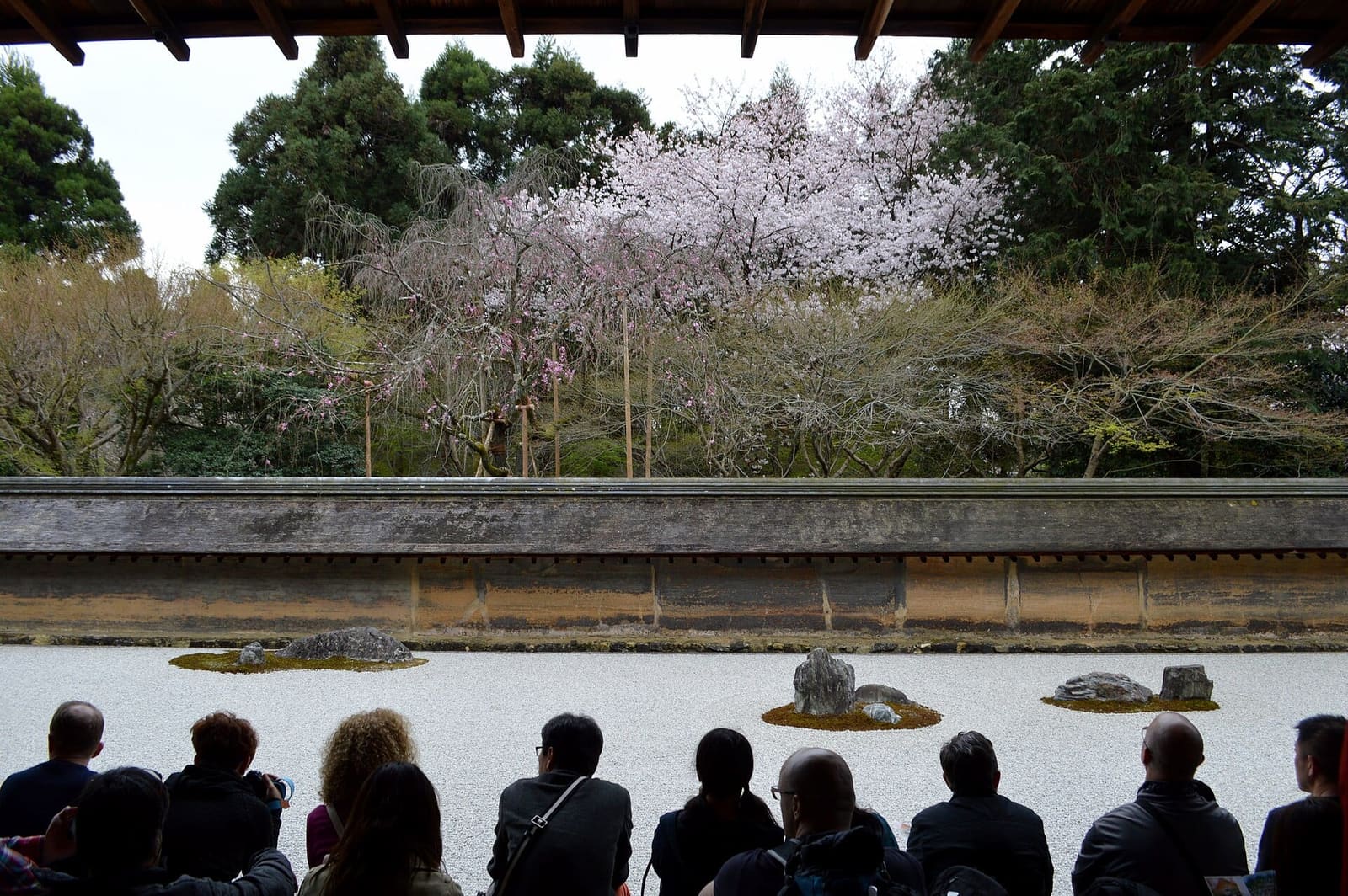
Photo: DimiTalen, CC0, via Wikimedia Commons
Try sitting down on the veranda of a Japanese temple and looking out at a flat courtyard of white gravel. The gravel has been raked into parallel lines, and fifteen stones lie scattered across it. There are no trees and no water. At first you may see almost nothing. Sit a little longer and each person starts to see something different: one sees the sea, another sees mountains, another sees only a stillness.
I am picturing this scene from photographs and books. It is not a memory. But it is exactly what books on Japanese gardens keep coming back to: a small courtyard that nobody can agree on how to read.
A Gravel Courtyard, Fifteen Stones
This is the garden at Ryoan-ji. According to Günter Nitschke in Japanese Gardens (Taschen, 2003, pp. 89–96), it is the purest kind of dry garden: no water, no trees, only stones on raked sand. My reading notes record the fifteen stones as split into groups of 7, 5 and 3. I am not sure of that split, since other sources describe it differently.
The garden was rebuilt around 1488, and nobody knows for certain who made it. Hennig lists fifteen hypotheses and leans toward a group of workers called sensui kawaramono, “riverbank people”: men who lived by the river and were used to digging earth and finding stones. Behind one of the stones there are even signatures of two stone carvers.
The cover photo shows the same scene as the opening: a row of people sitting on the veranda, the gravel courtyard sitting neatly inside the frame of the eaves. This type of garden is called kare-sansui, “dry mountain-water.” Gravel and sand suggest the sea; stones suggest mountains or islands. People do not stroll through it. They sit on the veranda of the abbot’s quarters (hojo) and look out from one fixed spot, the way you look at a painting. The veranda is the picture frame. Nitschke even describes this kind of garden as “three times removed from nature”: built like a painting, viewed from a distance, and in a single color.
Where the Dry Garden Came From
Shigemori divided the development of the dry garden into four stages (after Nitschke, pp. 66–88).
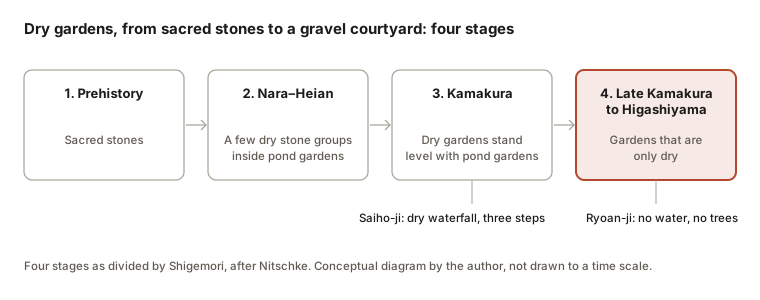
This division shows something easy to overlook: the gravel courtyard did not fall from the sky. It grew out of sacred stones, passed through a few stone groups sitting inside pond gardens, and arrived at a point where the pond was gone. Scholars still argue about whether kare-sansui was a Zen invention or simply the growth of a small garden type from the Heian period. That question is not settled. According to Kuitert, even the label “Zen garden” appeared fairly late, in the twentieth century.
Three Ways to Read
Nitschke uses three gardens to show how different dry gardens can be. I have gathered them into a table:
| Garden | What is there | How to read it |
|---|---|---|
| Ryoan-ji | Raked gravel, fifteen stones, no water, no trees | No single answer. Nitschke rejects explanations based on secret geometry or the story of the “tiger cubs crossing the sea.” He reads it through experience: the horizontal layout invites you to sit still and look at one spot, energy seems to go out and then turn back, and it leads to a feeling of “emptiness” |
| Daisen-in | A garden wrapping around all four sides of the main hall. Mount Horai made of clipped tea bushes, a white gravel “stream” that drops over a waterfall, two “rivers” flowing past a treasure-boat stone and a turtle stone moving upstream, and finally a sea of white gravel with two cones of gravel and a bodhi tree | Read as a story, from northeast to southwest, like the course of a life |
| Shinju-an | A strip of moss with fifteen stones along a slightly curved axis, a clipped hedge standing in for a wall, in the proportion 7:5:3 | Modest, like notes of music laid on a frame of architecture |
All three gardens use only stones and gravel, yet each speaks in its own way: one leaves a place empty for you to think in, one tells a story, one speaks softly. That grouping is mine.
Emptiness Is Also a Kind of Beauty
Shigemori found two ideals beneath the dry garden. One is yugen, a deep, refined beauty that hides many layers of symbolism underneath. The other is yohaku no bi, the beauty of empty space. Yo means “surplus.” Haku means “white.” Nitschke compares this with the Kamakura picture scrolls that leave the clouds and sky blank, and with Mies’s line “less is more.”
There is another way to pull the viewer away from the shape of a stone: give it a name. The Sansui narabini yakei-zu (1466) is a manual passed on by word of mouth among the stone-setting monks of Ninna-ji. It explains how to place stones according to the five elements, and how to name each one: “Stone That Never Ages,” “Stone of Floating Clouds,” “Stone That Hides the Boat,” “Stone That Anchors the Bridge.” An ordinary stone, once named, begins to have a story of its own.
So Which Reading Is Right?
By now it is tempting to ask: what does the courtyard actually say? Nitschke admits there is no document confirming his Zen reading, and who made the garden is still a matter of fifteen hypotheses. This reminds me of the question in Wrong Compared to What?: when the maker left no explanation, right compared to what? Each reading above is right about a different thing. History, the experience of the person sitting and looking, or a story being told. I think the courtyard is still standing partly because it can hold up under all three.
Try one small thing: pour a layer of rice or fine sand onto a tray, rake it with a fork, and set three pebbles on it. Sit and look for five minutes, then give each pebble a name, the way the 1466 manual did. Do you see sea or mountains? And what does the person sitting next to you see?
Note. The information comes from books I consulted, together with my own discussion. The diagrams are my own drawings.