Central Park: A Landscape Painting You Can Walk Into
The lawns, woods and lakes of Central Park look as if they were always there, yet every one of them was made by hand. How did Olmsted and Vaux draw the scene before and after, hide the traffic below ground, and bring the English way of making gardens to New York?
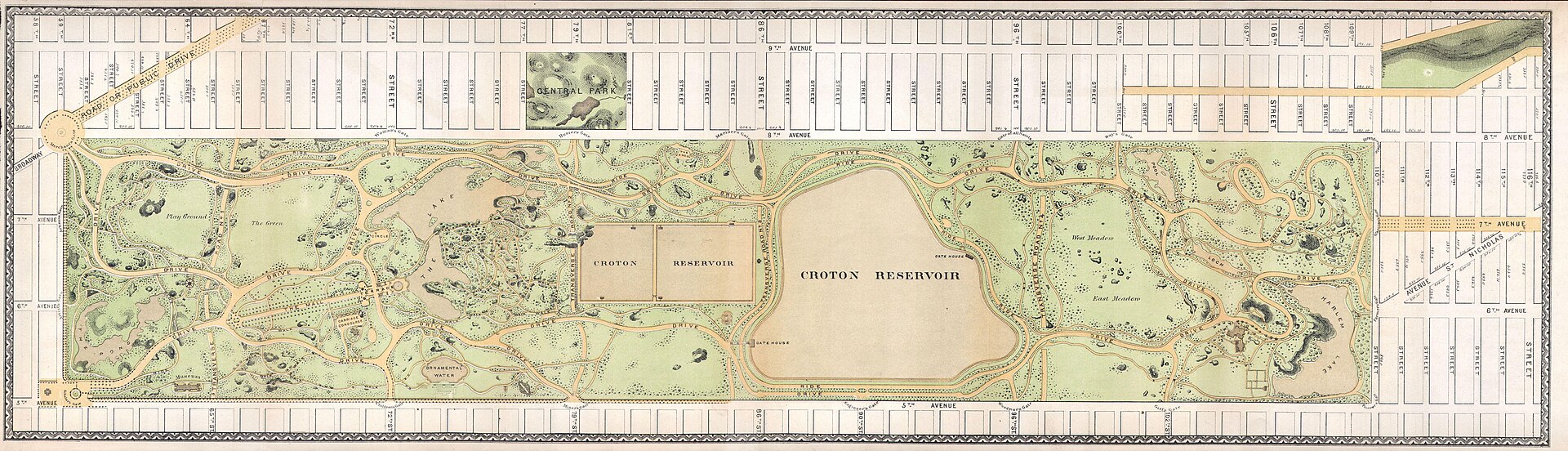
Photo: Calvert Vaux and Frederick Law Olmsted, map printed in 1868 (scan by Geographicus Rare Antique Maps), public domain, via Wikimedia Commons
Picture a landscape painting hanging in a living room: a gently sloping lawn, a line of trees, a still lake in the distance. You stand in front of it, look for a while, then turn away and get on with your day. Now suppose someone says: I am going to build that painting for real, dozens of city blocks long, and invite the whole city to step inside and take a walk.
That example is mine, not a memory. But it comes close to what Frederick Law Olmsted and Calvert Vaux did in New York in the middle of the 19th century. I read the story in Morrison Heckscher’s Creating Central Park (2008), and one thing stayed with me: almost nothing in that park was already there.
An Opening in a Grid of Straight Blocks
The plan of 1811 laid a grid of 12 avenues and 155 cross streets over Manhattan, ignoring the hills. A few decades later, people had started calling parks the “lungs” of the city. The nurseryman and author Andrew Jackson Downing demanded a park of at least 500 acres because, in his words, 160 acres was only a children’s playground.
In 1853 the Central Park Act set aside the land from 59th Street to 106th Street, between Fifth and Eighth Avenues, with the reservoirs in the middle. The design competition ran from October 1857 to April 1858 and drew 33 entries. First prize went to entry number 33, called “Greensward,” by Vaux and Olmsted. The book says the two men drew it at night, at Vaux’s house.
They made up for each other. Olmsted (1822–1903) had been a farmer and a writer, and at the time was the park’s superintendent of works. Vaux (1824–95) was an architect trained in England who had been Downing’s partner.
Draw What Is There, Then Draw What Will Be
The Greensward entry had 12 presentation boards, and 9 of them did the same job. Each one showed a view labeled “Present Outline,” the bare ground as it then was, next to “Effect Proposed,” the same spot once the trees had grown. Arrows marked where the viewer was standing.
Put two pictures side by side and anyone gets it: stand here, today you see this, later you will see that. In Drawing to See, Not to Show Off I wrote about drawings made to persuade; the Greensward boards belong squarely in that group.
Someone in England had drawn this way earlier. Hàn Tất Ngạn’s Kiến trúc cảnh quan (1999) reproduces Humphry Repton (1752–1817) drawing a landscape “before and after” improvement. My notes do not say Olmsted and Vaux took the method straight from Repton, so I am only setting the two side by side.
A “Natural” Scene Made by Hand
The book lists a good deal of work that a person out for a stroll never sees. I have arranged it in a small table; the table is mine, the figures are the book’s:
| What looks as if it was always there | What people did |
|---|---|
| Woods and lawns | Planted 240,000 trees, coordinated by head gardener Ignaz Pilat |
| Dry ground | Engineer George Waring Jr. and about 400 workers laid 105,000 ft of clay drainage pipe (roughly 32 km) by March 1859 |
| No buildings crowding the view | Buildings set in low places, almost hidden; the Terrace is nearly invisible from many spots |
| A gentle edge | A low stone wall, 3 ft 10 in (just under 1.2 m), so people on the street can see over it, plus 18 gates named after trades |
Vaux put it in a single line: nature first, second and third, architecture after a while.
Keeping the Scene Calm by Separating the Routes
The competition brief required at least four roads crossing the park. A long green strip sliced by four roads full of city traffic would hardly be a painting anymore.
Greensward sank all four of them. Traffic that had nothing to do with the park ran below. The park’s own paths crossed overhead and, as the book describes it, showed no sign of having been raised. At the time people thought it could not be done.
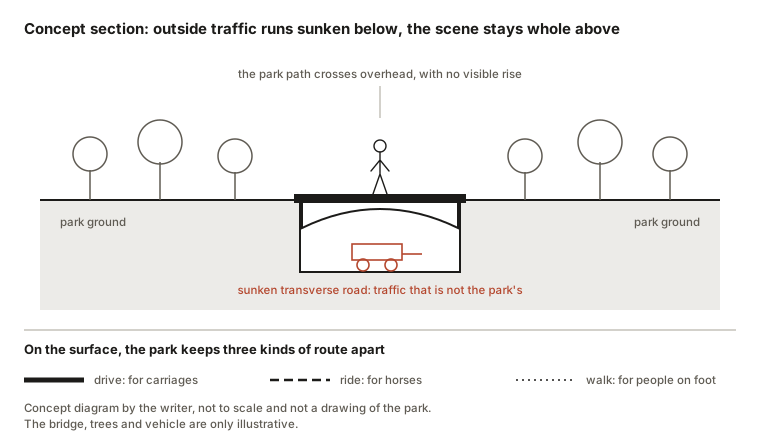
Inside the park, the two men also set out three kinds of route: the drive for carriages, the ride for people on horseback, the walk for people on foot. The book counts 13 bridges in stone and cast iron. On the map used as the cover, you can read the words “Drive” and “Ride” printed along the winding lines. I drew the diagram above from the description, only as an aid to picturing it.
Roots in the English Garden
This kind of scenery came to America from the English landscape garden, by way of Downing and then Olmsted and Vaux.
The English made gardens in the opposite way from French gardens like Versailles, which are laid out on axes and in symmetry. They believed a garden should stir the senses, so they let the paths wind, and each bend opened a new view. According to Hàn Tất Ngạn’s book (pp. 38–40), William Kent divided the scene at Stowe into three layers, as in a painting: foreground, middle ground, background. Brown added water with many small inlets. Repton gathered it into a theory: the foreground can be altered, the middle ground gives depth, the background stays as it is.
Both of my notes on the English garden add the same remark: that “natural” scenery is made by people from start to finish. So is Central Park.
A Painting with People in It
Olmsted called Central Park the first real park made in the country, a democratic development of the highest significance. For 1861 alone, the book records 1.86 million people on foot, 73,000 on horseback and 467,000 carriage visits. People skated, rowed and listened to music, which was not the quiet contemplation the two men had first hoped for.
The design also changed as it was built: the park was extended to 110th Street, and a few structures were dropped. A painting that people walk into does not hold still the way one on a wall does. It is very different from the courtyard in Ryoan-ji: Three Ways to Read a Gravel Courtyard, where people only sit on the veranda and look in.
Next time you are in a park near home, stop at the spot you find most beautiful and ask yourself: what here was already there, and what did someone arrange? Where do the roadway and the footpath meet, and is the scene still calm at that point? If you have a moment, take a photo and sketch over it the view you would like to see, a “before and after” board of your own.
Note. The information comes from books I consulted, together with my own discussion. The diagrams are my own drawings.