Drawing to See, Not to Show Off
Architects sketch not to produce a beautiful picture but to see something that does not exist yet. Six jobs a sketch can do, a few ways the masters used it, and a one-month habit for beginners.
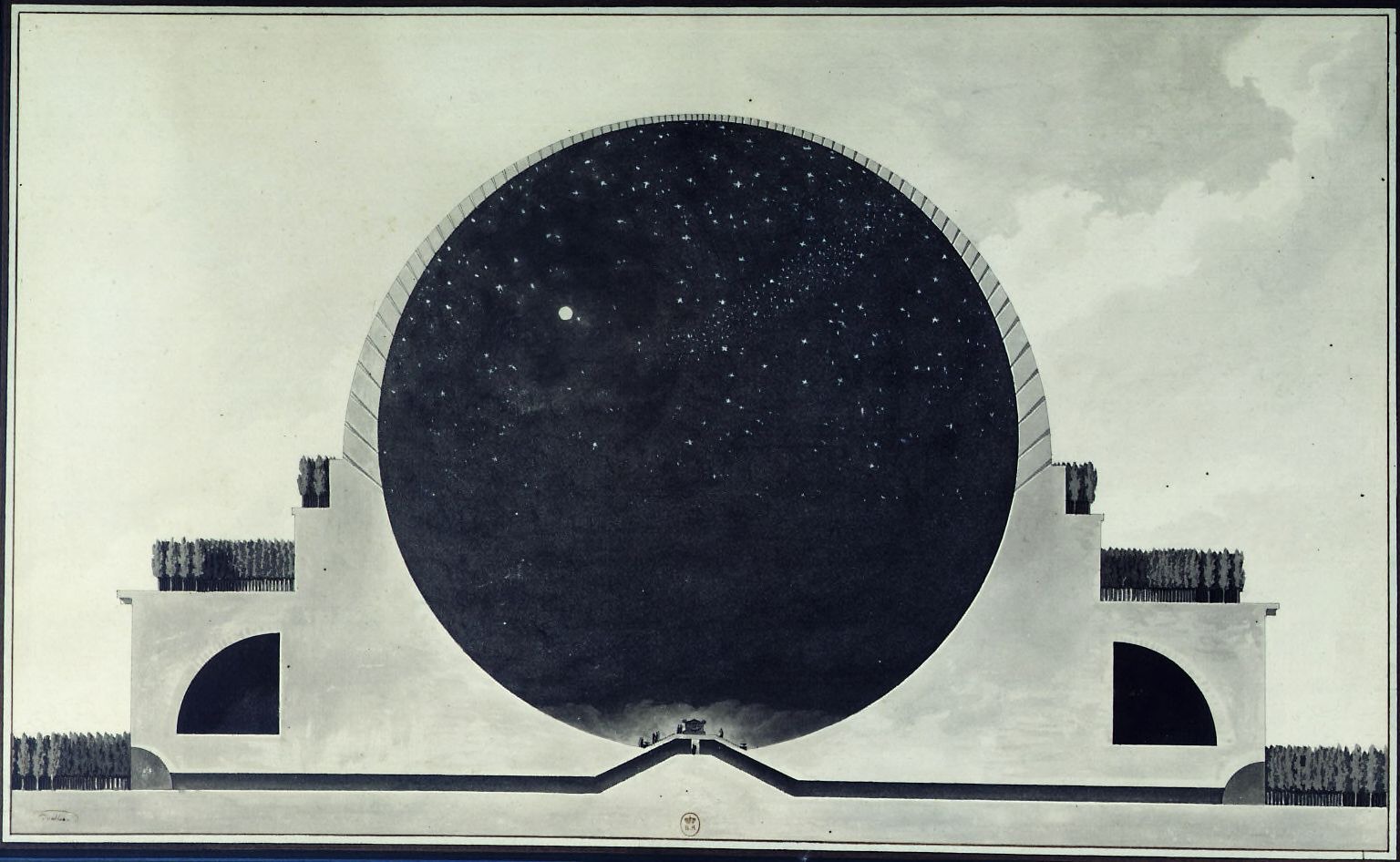
Photo: Étienne-Louis Boullée, Cénotaphe de Newton (section, page 4 of the album), public domain, via Gallica (BnF) and Wikimedia Commons
Many people say “I can’t draw,” because they think drawing means producing something beautiful. Architects draw almost all day, and most of their drawings never get hung on a wall. They draw the way the rest of us scribble a draft: to think, not to show anyone.
In Wrong Compared to What? I separated three kinds of “right”: right to the eye, right to the rules, right to the idea. A sketch adds a fourth: right for the job it has to do. An ugly drawing that helps its maker see something they could not see before is still a good sketch.
What a Sketch Is
In Architects’ Drawings (2005), Kendra Schank Smith defines a sketch as a preliminary drawing made to prepare for the next step. Its value lies in its role in the design process, not in its material: a pencil drawing, a clay model, or a wireframe model on a computer can all be sketches. Architects do not treat it as the final product (introduction, pp. 1–5).
The reason is practical: they cannot test a building at full size, so something else has to stand in so they can see it ahead of time.
Six Jobs a Sketch Can Do
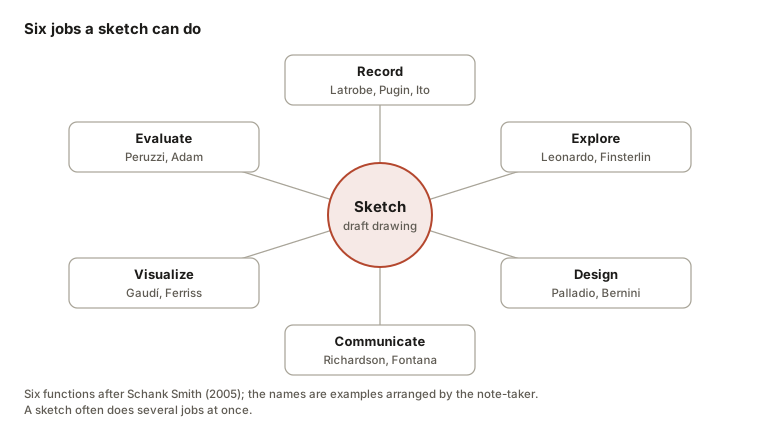
Smith lists six functions. The short glosses below are mine:
- Record: draw to hold on to something you just saw, like a travel sketchbook.
- Explore: draw to find out what you are thinking, before you know how it will turn out.
- Design: draw to choose a shape, to choose dimensions.
- Communicate: draw so someone else understands, whether staff or client.
- Visualize: draw to see ahead a place that does not yet exist.
- Evaluate: draw to “try it for size,” to see whether this fits in there.
A sketch often does several jobs at once. The names in the diagram above, from Latrobe, Pugin, and Ito to Leonardo, Palladio, Gaudí, and Ferriss, are examples recorded in my reading notes on the book.
Looking, Then Seeing
Scarpa said he trusted only what he could see, and he drew in order to see. Smith also cites Merleau-Ponty: a line does not imitate what has been seen; it makes it appear. These two statements turn the usual idea upside down. We tend to think you look first and draw afterward. For them, drawing is how looking takes shape.
Ando Does Not Erase
As Smith tells it, Tadao Ando’s sketch of the Church of the Light is drawn in marker on washi paper, dark ink on a white ground, with several plans and axonometric views stacked on one sheet. He does not erase; when he needs to draw more, he finds an empty spot. According to Ando, the sketch helps him clarify and refine his first image, and only then does he tie it to space and detail. I tell the story of that church in The Church of the Light.
Not erasing is a way of forcing yourself to keep going. The slowly filling sheet is also a record of the thinking.
A Promise, Not Proof
For Zumthor, a project drawing is a “preliminary promise” about a building that does not yet exist. He advises leaving a few gaps for the imagination, and stopping when the atmosphere you are looking for has appeared. I went into this in more detail in The Vals Baths. The point worth repeating here is the stopping place: a sketch does not need to be complete, only complete enough for the viewer to step in.
Drawings Also Persuade, and Also Hide
Some sketches are no longer a private conversation for the person drawing; they are a tool for persuading viewers while the building does not yet exist. Smith gives several cases:
- Boullée describes a pyramid-shaped memorial wrapped in storm shadow, and says the sadness lies in the light-absorbing plane of the ceiling, while ornament is just shadow. Through light, a diagram becomes an argument (p. 79).
- Ferriss used charcoal and an eraser to make light rise from below at Hoover Dam, valuing grandeur over accuracy (p. 109).
- Marion Griffin painted a triptych of Canberra in watercolor from Mount Ainslie to “seduce” the jury (p. 177).
- Fontana made a double door out of a folded sheet of paper so clients could choose (p. 61).
- Sant’Elia and Tatlin used decisive lines and dropped the context, to draw out an ideology (pp. 145, 153).
The cover image is another drawing by Boullée, which I chose because it is a section: a drawing for the Cenotaph for Newton, an enormous spherical building. The Gallica caption describes it as a daytime scene with a nighttime effect inside. Thanks to the section, we see the outer shell and the dark sky inside at the same time. That fits the name of this site: cut through to see what is inside.
My notes on this chapter add a warning: every persuasive drawing chooses what to show and what to hide, so when you use one, state clearly what was left out, such as context, dimensions, and cost.
How to Practice: Three Passes and One Month
In The Urban Sketcher, Marc Taro Holmes lays out a three-pass way of drawing, so that the measuring work of reason stays separate from the pleasure of the line. Pass one is pencil: a loose hand, drawing from the outside in, measuring and checking angles, blocking in the shadow shapes; if something is off, you draw over it rather than erase. Pass two is a ballpoint or fountain pen: a confident line, with gaps left open and varied weight. Pass three is a brush pen or a brush with ink, filling in the important dark areas. Every black spot is a decision about where the eye will rest (pp. 40–65).
For beginners, he suggests a one-month habit (pp. 10–11): always carry minimal drawing supplies, such as a pocket sketchbook about 8 × 13 cm, a pencil, and an eraser; draw in every spare moment, a few minutes at a time; find subjects right around you; do not grade yourself, just count how many pages you have filled. When one book is full, start another. According to the book, urban sketching is an international movement started by Gabriel Campanario in 2007, built on drawing on location, from direct observation, and sharing freely.
The supplies in the book are North American; in Vietnam, equivalent ones will do.
Tonight, try a three-minute exercise: draw the chair you are sitting in with a ballpoint pen, no erasing. Then ask yourself: what does this drawing let me see that I could not see a moment ago?
Note. The information comes from books I consulted, together with my own discussion. The diagrams are my own drawings.