The Church of the Light: A Dark Room with Just One Slit of Light
Tadao Ando's small church in Ibaraki has almost nothing but concrete, darkness, and a cross-shaped slit of light. Why does taking away openings make the light the most memorable thing in the room?
Photo: Chun-Hung Eric Cheng, CC BY 2.0, via Wikimedia Commons
Close the curtains tight one morning… The room goes dark, and only a thin streak of light slips through the gap between the two panels. Oddly, that streak lets you see more than a wide-open window does: dust hanging in the air, the edge of a table, a corner of the floor that suddenly has color. Maybe light only really appears when darkness wraps around it.
This example is mine, not a memory. But it comes very close to what Tadao Ando did in a small church on the outskirts of Osaka, a place with almost nothing but concrete, darkness, and a cross-shaped slit of light.
Ando was born in 1941 in Osaka, taught himself architecture through books and travel (1963–69), and received the Pritzker Prize in 1995. He designed the church in Ibaraki around 1987–88, and people know it as the Church of the Light.
A Box Cut at an Angle
In Architects’ Drawings (2005), Kendra Schank Smith relays how Ando himself describes the building: a rectangular block, sliced at 15 degrees by a freestanding wall. The floor and benches are made of cheap scaffolding boards. There are very few openings, because light only blazes against a dark ground. And the cross on the wall behind the altar is the one place where light gets in.
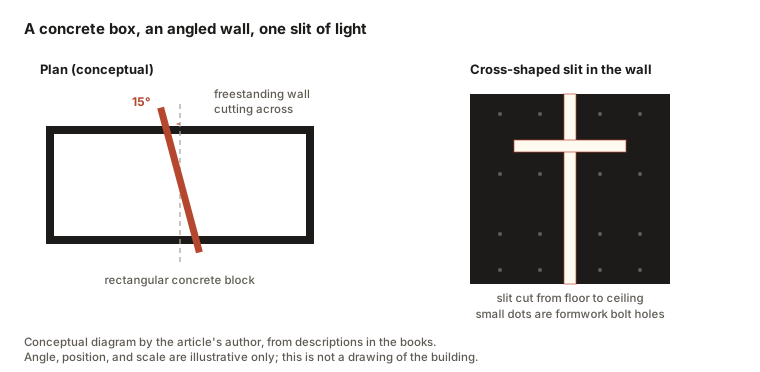
The two drawings above are my own simplified versions, following that description. On the left is the plan: the box and the angled wall. On the right is the wall with the cross-shaped slit, seen head-on. The angle and position of the wall are only illustrative; the book does not say where the wall sits relative to the altar.
The Cross-Shaped Slit
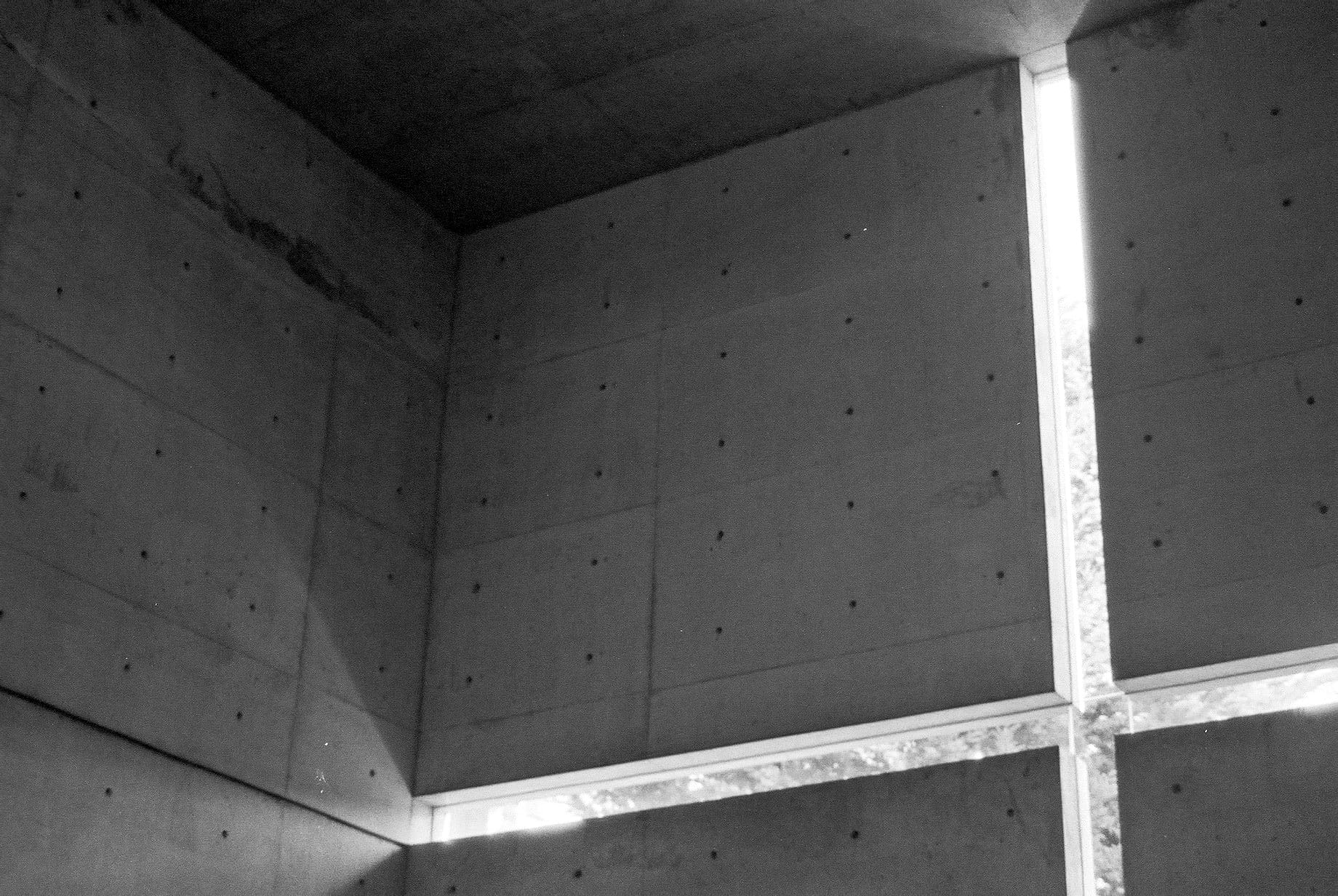
Maria Akl, in Light and Architecture (2011), describes light passing through a cross-shaped slit behind the altar, cut straight from the floor up to the concrete ceiling. For her, the cross here is an “event” of light: abstract, belonging to no one in particular, and standing against the dark mass of concrete. The whole room is that plain, and the only thing that breaks the plainness is the brightness of the cross.
My own reading goes like this: the cross here is not made of wood or metal, it is where the wall has been left empty. What we see is the part that was held back. This is my own interpretation; Akl does not write it that way.
A catalogue from Lyon in 2008 records what Ando wanted: an empty, pure space “like a lighthouse waiting for light,” where people touch the outside world only through light sliding along the wall and through a sense of wind and rain.
Concrete and Scaffolding Boards
Ando’s concrete is poured on site, so the walls still carry the grain of the wooden formwork and the bolt holes. In his introduction to The Colours of Light (Pare, 1996), Tom Heneghan says this concrete “does not feel heavy”: the surface is even and light, yet it shows the pour lines and the marks of the workers’ hands. Wherever hands and feet touch, Ando chose natural materials; to my mind, the scaffolding-board benches fit that habit too.
The small, evenly spaced dots on the wall in the cover photo are those bolt holes. They give the eye somewhere to rest while the light has not yet arrived.
Two Ways of Using Darkness
In an earlier piece, I told the story of Kahn and Kimbell: there, darkness is the backdrop for a silvery light that falls softly on paintings. Put the two buildings side by side and you find the same idea, done in different ways.
| Kimbell (Kahn) | Church of the Light (Ando) | |
|---|---|---|
| How light gets in | A slit at the top of the vault, then a detour around a reflector | A cross-shaped slit in the wall |
| Shape of the light | Soft and spread out, many streaks | One firm streak |
| What the darkness is for | Rest for the eyes; it still needs a slit of light so you can tell how dark it is | A ground that lets the single streak stand out |
| What the light is for | Seeing the paintings | It is what you came to see |
I arranged this table from my notes on the two buildings; it does not come from either book.
A Sketch Without an Eraser
Smith also mentions Ando’s sketch of the Church of the Light: drawn with a marker on washi paper, dark ink standing out against white, with several plans and axonometric views stacked on the same sheet. He does not erase. When he needs to draw more, he looks for an empty spot to continue.
In Ando’s own words, the sketch helps him clarify and refine his first image, and only then does he tie it to space and detail. I wrote about this way of working, and why a messy sketch can still be a good one, in Drawing to See, Not to Show Off.
Bringing It Home
Before copying any of this, a bit of caution is in order. Most of the praise for Ando in the material I have comes from critics who already admire him. Taking it to a Vietnamese house is harder still: my notes say his kind of open-sky courtyard must account for rain, heat, and humidity.
One more thought, and it is only my own: in a place with a lot of sun, a narrow slit in a closed wall can easily become a point of glare and heat. Kahn faced exactly this problem in Luanda, and he placed a sun-blocking wall a few steps from the window, as I described in Good Light Is Not Plenty of Light. So what we can take home may be just a few small things rather than a whole church: fewer openings, a dark ground, and light only where it deserves to enter.
Try it one morning: close the curtains and leave a single gap. Then sit still for a while.
In your own room, where is it dark enough for a small streak of light to become a big event? Perhaps the answer sits in a corner you walk past every day, every day… without once stopping to look.
Note. The information comes from books I consulted, together with my own discussion. The diagrams are my own drawings.